NeuroStar Advanced Therapy
TMS: treating depression at the source.
If antidepressants haven't worked, that doesn't mean nothing will. NeuroStar TMS is a non-drug, non-invasive treatment that works directly on the areas of the brain that regulate mood — and it's covered by most insurance plans.
19 min
A typical session. Awake the whole time, back to your day right after.
How it works
Antidepressants travel through your whole body to reach your brain. TMS skips that entirely. Specific regions of the brain regulate mood, and when the connections there are underactive, depression can follow. NeuroStar sends focused magnetic pulses to those regions to reactivate them — no medication, nothing systemic, no effect on the rest of your body.
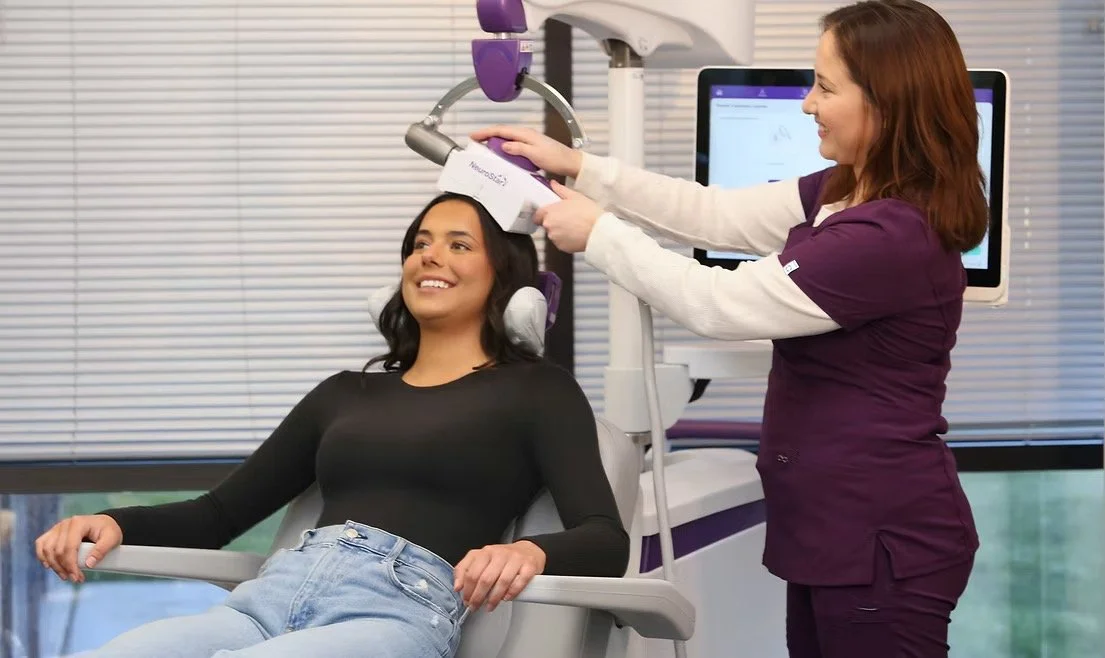
You sit in a chair, awake and alert. A cushioned coil rests against your head. Most people feel a light tapping or warming where the coil sits, which usually fades after the first few sessions. When it's over, you drive yourself home and get on with your day.
Consultation
We review your history, what you've already tried, and whether TMS is a fit. Free, no obligation.
Insurance & mapping
We handle prior authorization with your plan. Your first visit maps the precise treatment location for your brain.
Treatment
Short daily sessions — as little as 19 minutes — over several weeks. You stay awake and resume normal activity immediately.
83%
Saw measurable improvement*
62%
Reached complete remission*
19 min
Typical session length
Ages 15–70
FDA-cleared range
Is TMS right for you?
TMS gets talked about as a last resort. It doesn't have to be. Many people come to it earlier — to avoid years of medication trials, or because they'd rather not add another prescription to the list.
You may be a candidate if you:
- Are between 15 and 70 and have been diagnosed with Major Depressive Disorder
- Have tried at least one antidepressant without adequate relief — insurance often requires three or more
- Have participated in therapy
- Want an option that works alongside therapy rather than replacing it
NeuroStar is also cleared as an adjunct treatment for adults with obsessive-compulsive disorder. If you're not sure whether you qualify, the consultation is free — that's what it's for.
Common questions
Does it hurt?
Most people describe a tapping or knocking sensation on the scalp during treatment. It's often uncomfortable in the first few sessions and then fades as you get used to it. It isn't painful for most patients, and there's no sedation or anesthesia involved.
Will it make me feel foggy or tired, like medication does?
TMS doesn't go through your digestive system or circulate through your body, so it doesn't carry the systemic side effects people associate with antidepressants — weight gain, sexual side effects, sedation. The most common side effect is scalp discomfort or a mild headache, which usually resolves quickly.
How long is the whole course of treatment?
TMS is a daily commitment over several weeks, not a one-time procedure. We'll walk you through the exact schedule at your consultation, since it depends on your protocol and your insurance authorization.
Can I drive myself home?
Yes. You're awake and alert the entire time, and you can go straight back to work, school, or whatever else you had planned.
Do I have to stop my medication?
No. TMS is often used alongside medication and therapy rather than instead of them. Any changes to your prescriptions are a conversation between you and your prescriber.
Will my insurance cover it?
Most major plans cover TMS for major depressive disorder, though nearly all require documentation of failed medication trials first. We handle the prior authorization process with your plan and will tell you what your coverage looks like before you commit to anything.
Start with a conversation.
The consultation is free and there's no obligation. If TMS isn't the right fit, we'll say so and point you toward what is.
The NeuroStar Advanced Therapy System is indicated for the treatment of depressive episodes and for decreasing anxiety symptoms for those who may exhibit comorbid anxiety symptoms in adult and adolescent patients (15 and older) suffering from Major Depressive Disorder (MDD) who failed to achieve satisfactory improvement from previous antidepressant medication treatment in the current episode. NeuroStar Advanced Therapy is also intended to be used as an adjunct for the treatment of adult patients suffering from Obsessive-Compulsive Disorder (OCD).
NeuroStar Advanced Therapy is available by prescription only. A doctor or nurse practitioner can help decide whether it is right for you. Patients' results may vary. Visit neurostar.com for full safety and prescribing information.
*Outcomes Registry data published in Sackeim HA, et al. J Affect Disord. 2020;277(12):65–74. Results represent the subset of study patients for whom CGI-S data was reported before and after an acute course of NeuroStar TMS. Patients were treated under real-world conditions and may have been receiving concomitant depression treatments, including medication. “Measurable improvement” was defined as a CGI-S score ≤3; “complete remission” as a CGI-S score ≤2 at the end of treatment.